Sunday, 19 January 2014

Food Adventure 16: Soondae

Hi everyone, Liz here. It's been a while since I've been on, but I'm back with another weird Korean dish! Today I'll be talking about a dish called: sundae. Sundae is pornounced: soon-day, and it can also be spelt as soondae.

I apologise for the unflattering photo, there really was no angle that could've made this any more appealing

Though there are different variations of sundae, the most common type is the one pictured above: made of pig's intestines and a stuffing of cellophane noodles, barley and pork blood.

Sundae uncut, I really was not joking when I said there was no angle that could make this dish appealing.
cr: http://koreanfood.about.com/od/holidaysandoccasions/ig/KoreanFest/Soondae.htm

As unappealing as it looks and sounds, sundae is a popular dish which has been enjoyed for years and years. It should be noted, however, that sundae has a quite 'strong' smell, something which turned me off of it until recently - but, the dish itself is pretty yummy.

How sundae is generally served when bought
cr: http://samchoitravel.blogspot.com.au/

Sundae is traditionally eaten with salt and chilli powder, pig liver and ear. Yeahp, pig liver and ear. It can also be incorporated in different Korean dishes, for example: sundae soup or stir fry with sundae, or mixed with other dishes, such as ddeokbokki.

This dish can be easily and commonly found in the street stalls or even certain restaurants in Korea. Sundae can also be bought here in Australia, from a Korean grocery store.

So that's it for today. I hope everyone enjoyed today's post, even though it may have looked particularly unappealing, and happy eating until next time. Liz.

Food Adventures 15:Snake soup


Unbelievable to the foreigners? It’s snake!!!
source: http://www.diarygrowingboy.com/2010/12/stuffed-like-duck.html


Snake soup is a popular Cantonese delicious and healthy dish in Hong Kong, which contains at least two types of snake meat as main ingredients. The taste of the soup a slightly sweet flavor with chrysanthemum leaves and the texture of snake meat is actually similar to chicken flavor.

A typical snake soup recipe requires at least two types of snakes, their meat was shredded into wires boiled with chicken, lean meat, fish maw, mushrooms, ginger, lemon leaves and other spices. The mixture is stewed over six hours seasoning with salt pepper and soy sauce to taste. Corn starch is added to make it into thicken soup rather than broth. Snake is in pale pink color. Compared with fish and chicken, snakes taste is richer and chewier.


The cabinets storing live snakes.
source: http://www.openrice.com/restaurant/commentdetail.htm?commentid=2049819


Snake soup has been a long historical delicacy in Chinese culture for more than two thousand years. Snake soup is considered a high class dish because of its variety of components and complex preparation. It is a symbol of wealth, courage and respect. It was only served to the certain officials and celebrities and became common in the later. Nowadays in Hong Kong, the number of snake soup store has declined because of food price inflation and rising rents. It is also difficult to find a successor. Fewer people enter the industry because of the difficult and dangerous preparation process.
 

source: http://www.nanzao.com/sc/lifestyle/16665/she-geng-xiang-gang-ren-de-nuan-dong-jia-pin

 
Hong Kong's history is scattered in every corner of every street. Snake soup store is one of them. Having a sib of snake soup and been served by the old waiters, you can find a smell of old Hong Kong style.


Saturday, 18 January 2014

Food Adventure 14: Kvas

Hi it's Kim here- today I'm going to introduce you to a popular Russian drink, which hails from way back long time! Though many people sometimes make this peculiar drink themselves, it can typically be found in large barrels on the side of the street during the dusty Russian summer.


The drink is called Kvas (квас), and it is made by fermenting black rye bread, to create what can almost be considered a light beer. However the alcohol percentage is so low that children can drink it, and it is not considered an alcoholic beverage under Russian classifications.

I sourced mine from Sydney's closest thing to a street-side keg: Stolichniy Minimart in Eastlakes- a specialty store which stocks a whole range of Russian and Eastern European products.


I read warnings online about companies selling short-cut kvas products which rely on sugar, carbonated water, and flavourings, so I have some doubts about the authenticity of my kvas...


Kvas is touted by patriots as a Russian alternative to cola, and as I take off the lid, it releases a gassy hiss. The colour is definitely comparative. It has an interesting and unexpected smell... a bit like diluted Vegemite?

Bottom's up...well? It has a little kick to it, but generally tastes like watery bread with bubbles. It's not a particularly offensive flavour though.

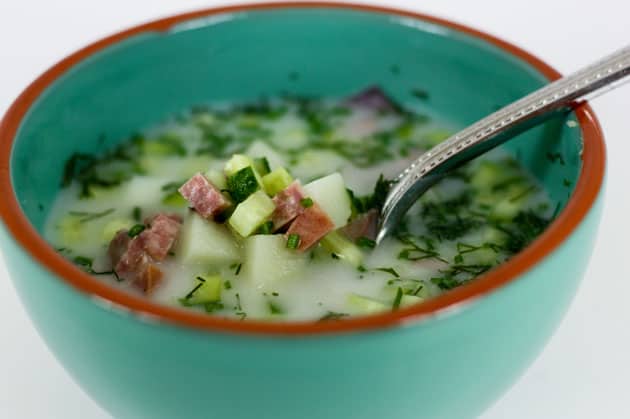
Kvas is also the signature ingredient in a strange Russian dish called okroshka (окрошка)- a cold soup made with raw vegetables, sour cream, and various other ingredients such as eggs, boiled potatoes and meat.

Image source: Natasha's Kitchen

Cold soups aren't really my thing, but if you're keen, you'll find a recipe here. Приятного аппетита!

Friday, 17 January 2014

Food Adventure 13: Chicken Livers


Hey guys! Mili here again, but this time we explore the scrumptious livers of chicken!
This food is very popular in my household and I'm sure it's the same for many Serbian families. They all think its brain food! I'm not to sure about that though.
You either love them or you hate them, but you wont know until you try them.


http://food.sulekha.com/recipes-with-ingredient-chicken-livers.htm

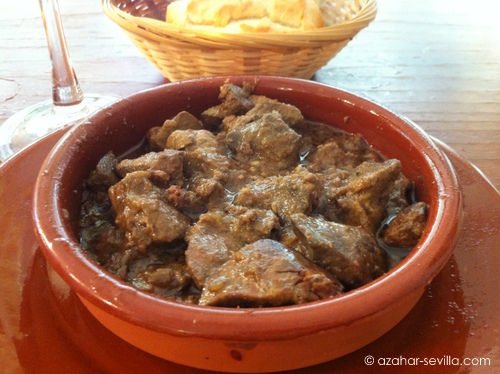
The below image shows what cooked chicken livers look like. Its one of the most simple dishes i make. All you need its onions, oil and the livers, fry it all of and ta-da! You've got fried chicken livers. They taste best served with fresh mash potato.

If you do cook with chicken livers keep in mind that they cook really fast and it's easy to ruin them and make them chewy. Be sure to cook them on a high heat first them simmer so they go pink but at the same time all the juices from the onion and livers make a gravy.


http://azahar-sevilla.com/sevilletapas/2013/06/bar-alfaro-photos/

Many people believe that chicken livers are a healthy food. Well it depends, some people will say its the best food for you whereas others will say its extremely high in cholesterol. If you find it yummy, don't have it in excessive portions! Everything is good in moderation, right?


Chicken livers can also be made into a delicious pate you can visit the below link follow Jamie Oliver's recipe on Chicken Liver Parfait
http://www.jamieoliver.com/recipes/chicken-recipes/old-school-chicken-liver-parfait


Chicken Liver Parfait
http://www.jamieoliver.com/recipes/chicken-recipes/old-school-chicken-liver-parfait
Enjoy cooking and trying the new flavours!

Wednesday, 15 January 2014

Food Adventures 11: Stinky Tofu

   Food Adventures 11: Stinky Tofu


For someone, it’s smelly like poo. But for someone who like it, it’s a gourmet.
picture: http://www.honeyandsoy.com/smelly-tofu/


Stinky Tofu is one of the famous and traditional Chinese snacks. Its a fermented soy product usually come in a dry or creamy texture. The reason why it is called "Stinky Tofu" is because it smells very stinky. For many foreigners, its special kind of smell is similar to excreta. The original tofu is actually a cream color and tasteless soy product, but it becomes very brown and stinky after natural fermentation. In Taiwan, soaking is the common way to make the stinky tofu. Tofu is soaked in rice washing water with some vegetables, then placed under room temperature for fermentation. That particular odor will come out after certain time.

 
picture: http://www.honeyandsoy.com/smelly-tofu/


Deep frying is commonly used as cooking method in Taiwan, Hong Kong or Shanghai. The tofu is soft, multi-layered on the inside and crispy on the outside Stinky Tofu that sold by Taiwanese vendors are often used to match pickles, as Hong Kong ones are used to served with chili sauce and sweet sauce. Fried stinky tofu is common in traditional Taiwanese cuisine, night market or restaurant.


When you go to travel Hong Kong or Taiwan, you can always spot the market stand selling stinky tofu because the odor is very strong that you can smell it even stand in 50m away. Some people said even blue cheese is a lot better than it. By my experience, the odor would last on my body for couple hours after having it. So, do you dare to try?


Tuesday, 14 January 2014

Food Adventure 10: Selyedka pod shuboi

Hi everyone this is Kim. Today I’m going to share with you a Russian salad known as Селедка под шубой (Selyedka pod shuboi), which is literally translated as “Herring under a fur coat”.

Селедка под шубой (Selyedka pod shuboi)

Like many Russian dishes, it’s a bit of a visual assault and it may take a moment for your eyes to adjust to the intense fushia colouring that dominates this dish.

Selyedka pod shuboi consists of 5 simple ingredients:


·        Salted herring
·        Boiled potato
·        Boiled beetroot
·        Mayonaise
·        Hard boiled eggs

Shell the eggs, and use your fingers to peel the skin from the beetroot and potatoes (quite easy to do once boiled).

Get someone else do the beetroot to avoid staining your fingers.

Dice the herring into little squares and arrange over base of the plate. Grate all potatoes (the main ingredient) to create a large mound. (Optional: we added extra herring on top of the potato.) Generously smear mayonnaise over the mound of potato. 


Grate all the beetroot and distribute evenly to cover the whole mound. Generously smear more mayonnaise over the beetroot. Grate the eggs over the top for the final touch, then tidy it all up.


It’s actually looking pretty good at this point. Am I crazy to be a little bit excited?


I decided to mix it all together. Here goes nothing…


The verdict…actually quite yummy- I even went back for seconds.

You barely taste the herring, and the other flavours are far from offensive. The main flavour is potato, the herring adds a touch of salt, the mayonnaise makes it creamy, and the beetroot provides a little zing. And because it’s made of root vegetables, plus two sources of protein, it’s quite filling for a salad. 

This one's a keeper!

Monday, 13 January 2014

Food Adventure 9: Casu Marzu

Hello fellow food adventurers! This is Drew here, welcome to another delicious addition of our summer food adventures! Today I have quite the treat for you cheese lovers out there as I will be writing about the infamous delicacy Casu Marzu: rotten cheese swarming with thousands of live fly larvae! Delicious!

Casu Marzu is a sheep' milk cheese that hails from the island of Sardinia, an autonomous region of Italy located in the Mediterranean Sea. The locals there, not being content with the pungent aroma and biting taste of lesser ordinary sheep' milk cheese, deliberately infest this abomination with hundreds of eggs from the cheese fly Piophila casei and leave the cheese outside - uncovered- to allow it to fester. 

"Rotten Cheese"


Once the eggs hatch, the larvae eat through the cheese, producing enzymes as a waste product that promotes fermentation and breaks down the cheese's fats which dramatically softens the cheese's texture, making it ready for consumption. Once the cheese is sufficiently fermented, it is sliced into thin strips (maggots and all), laid onto flatbread and served with a strong red wine.

The cutting of the cheese is supposed to be a traumatizing affair, with maggots often leaping up to 6 inches high when disturbed. To protect their eyes from these acrobatic larvae, locals often wear eye patches and/or safety goggles. Another safety precaution exercised by locals is wrapping the cheese is a plastic bag and suffocating the maggots. This method is predominately used by people who don't wish to ingest live maggots, however it is looked down upon by purists who claim eating the live maggots adds to the cheese's flavor and eating experience.

Yum!


Casu Marzu is described as a very soft cheese which oozes 'tears' known as langrima that adds incredible bite to its already potent taste. The flavor of the cheese is said to be very pungent, and is often described by locals as being so strong that it burns on the tongue. Casu Marzu is very popular among the locals of Sardinia and the cheese is often presented at special events such as birthdays and weddings. 

Despite its popularity in Sardinia, Casu Marzu is actually illegal to purchase in shops due to health regulations and the ingestion of Casu Marzu has been known to induce significant illnesses such as enteric myiasis and intestinal larval infection. Patients who contract intestinal larval infection by ingesting the maggots in Casu Marzu reportedly experience severe abdominal pains and bloody diarrhea as a result of the cheese larvae burrowing through their intestinal walls.

Piophila casei larvae


In spite of the significant health risks, Casu Marzu remains in high demand and although it can not be legally sold in shops, it can be bought on the black market for double the price of ordinary cheeses. Would you be willing to risk eating Casu Marzu? What other crazy foods do you know of? Let us know in the comments below!


Food Adventure 8: Sannakji

Hey Guys, welcome to the latest installment of Food Adventures! Today I'll be writing about the deliciously deadly dish known as Sannakji, a delicacy native to South Korea which consists of live octopus tentacles cut up into small pieces and lightly seasoned with oil and sesame seeds.

Bon appetite!

This dish is considered to be the ultimate challenge for food adventurers who have a penchant for the bizarre, but has gained significant notoriety in recent times due to the number of people choking to death on the octopuses' (yes, that is a correct plural for octopus) flailing limbs.

It is reported that in South Korea, up to 6 people a year die  from asphyxiation after tentacles become lodged in their throats. This is due to their powerful suction cups, which have a nasty habit of attaching to the inside of diners' throats after the tentacle is swallowed.


"But Drew", I hear you asking, "how can the octopi (also a correct plural for octopus) still be alive and use its suction cups after it is cut up into tiny pieces? Don't you mean RAW octopodes?" (seriously, there are so many ridiculous plurals for octopus). "How can we believe anything you say after this erroneous piece of shoddy journalism? No wonder your blog only has 300 views". "Just because it's on the internet, doesn't make it true".

First of all: ouch. Secondly, the octopus tentacles served in the dish, although cut up, ARE considered to still be alive thanks to the octopus's incredible nervous system and the sheer amount of  neurons that reside in their tentacles. These neurons are responsible for cognitive coordination- movement, problem solving and reaction, so even if the brain is no longer functioning, the the octopus's tentacles can still respond to stimuli and function normally, even if they are severed from its body.

Looks delicious.....


This means that even when swallowed the tentacles can still react to their environment and move independently. In South Korea, there are even reports of people eating and swallowing live octopus tentacles only for them to squirm and crawl out their mouth and/or nostrils. To combat this, Sannakji chefs recommend that the tentacles be chewed as thoroughly as possible and drink lots of liquid whilst doing so to encourage the tentacles to move to the stomach.


Would you ever consider eating Sannakji or any food that is alive? What is the most bizzare food you have ever eaten? Sound off in the comments below.

Food Adventure 7: Jamie's Italian

There is nothing like being forced to try a food that you despise! Mili here! As a child i was chased around the house by prawns and their googly eyes, hence why I dislike seafood so much! So my boyfriend and I decided to explore Jamie's Italian on Pitt Street, Sydney. I'm sure you can already guess, i was pushed into having crispy squid as an entree. For most people this isn't a big deal, but for me this was like a vegetarian having meat for the first time!

This was the best seafood i have ever eaten! The hint of chili and herbs almost ruled out the seafood flavour, and the squid wasn't chewy. But I have to say seafood still isn't my favourite, and i'll probably never have the dish again or any other seafood dish.

This was something different for me, I enjoyed it for the time being, but it's back to meat for me!

Mili!


Crispy squid and an Italian bread selection


So enough seafood talk, here is the real deal! 


This restaurant is so unique with its narrow structure

We had to have a chocolate lava cake before we left!

Sunday, 12 January 2014

Food Adventure 6: Mizuya

Hi everyone, it's me Liz again! Hope everyone's been enjoying our food adventures so far! Today I'm going to be talking about a Japanese restaurant called Mizuya. (Unfortunately, I always forget to take photos when I go, which is why a) there is a lack of photos, and b) the photos that have been used will all be credited to other people.)

cr: http://mydatewithfood.blogspot.com.au/2010/08/mizuya-chinatown-night-market-sydney.html

Miuzya is a restaurant on George St. in the CBD: but it's underground, so it manages to fit a large restaurant, bar and multiple karaoke rooms as well!

Though they serve the usual stereotypical sushi, you can try various other Japanese or Japanese style dished as well. One particularly out there dish that I've tried there is ox tongue. Yeahp folks, you read that right: ox tongue. It sounds a bit daunting, but it really honestly tasted like a piece of tender meat - it's only if you think about the fact that you're chewing a tongue does the experience get weird. Taste wise though, it was really good.

Just your usual ox tongue
cr: http://www.sugarpuffi.com/2010/02/mizuya-japanese-restaurant-and-karaoke.html

But if ox tongue is a bit too much for you, which is understandable, there's a various selection of delicious dishes to choose from. The desserts and drinks (there is a selection of both non-alcoholic and alcoholic) are also really, really yummy as well.

Here's the website for more information: http://www.mizuya.com.au/. Be sure to check it out, even if it isn't to eat ox tongue, there's sure to be something everyone'll like.

Happy eating, Liz.

Saturday, 11 January 2014

Food adventure 5: Hong Kong Style French Toast

Hi guys, My name is is Paul. Today I am going to share with you a traditional Hong Kong Snack called Hong Kong Style French Toast.


Butter on top then melt into the toast when u eat...Yummy!!
Image source: http://4-the-love-of-food.blogspot.com.au/2011/08/cafe-de-hong-kong-expect-french-toast.html
It’s actually not French and it’s not toast. It has so little nutritional value and low cost that perhaps it isn’t technically food either. It is, however, one of our favourite local Hong Kong desserts. It's two slice of sandwich bread slathered with peanut butter, completely coated with the egg mixture, deep fried in oil until golden brown. It is finally served with still more butter and lots of syrup on the top. It is made of simple ingredients, but the perfect combination creates a sweet and savoury, soft and crispy flavours and textures. Too much of this with fat and calories will send you to an early grave, but I believe one hour workout will be worthy in return of a delicious bite. It is also on the list of U.S. Cable News Network (CNN) 's travel site CNNGo selected the world's top 50 dishes.


French Toast is a common breakfast in North America and Europe, originated in France. Traditional French is intended to use up leftover bread, often stale from exposure to the air. Sometimes flavorings such as cinnamon or vanilla are added to the egg mixture. The staleness of the bread helps keep the slices from becoming soggy in the middle. The receipt of French toast in Hong Kong now is quite different from the original one which is low heated in a frying pan. In order to meet the taste of local Hong Kong and cook under shot production time, It often is stuffed with sweet filling and then deep fried. Kaya paste (coconut egg jam from South Asia) can be replaced by peanut butter to create a tasty mixture of eastern and western food culture. 

Unlike its more restrained Sunday brunch, Hong Kong-style French toast is for when you're stressed out and looking for a warm, deep-fried hug anytime. When next time you find the leftover dried sandwich bread at home, Please don’t waste it because you can try this delicious recipe by yourself following the video as below.
 

Friday, 10 January 2014

Food adventure 4: Karen Feast

Hi guys, this is Drew here. Today I will be telling you about my food adventure in Huay Pakoot, a remote Karen village in the hillsides of Northern Thailand, where I came to volunteer with the local elephant herd and to teach English to the children and mahoots (elephant herders) of the village.

The view of the valley from base camp
When I first arrived at the village I thought that living in such a remote and impoverished place would be a massive culture shock and that living with a host family, whose values and diet differed to my own, would be very challenging. I was dead wrong.

The people of Huay Pakoot are friendly, warm and generous, often going to great lengths to ensure their hosts are as appeased and comfortable as possible. When it comes to my great love, food, the villagers spared no effort in providing me and my fellow volunteers with some of the most mouth watering and delicious foods I have ever eaten.
The villagers of Huay Pakoot
Every night my host family laid out a platter of food for me consisting of a variety of dishes which  included sumptuous chicken and beef curries, a variety of fresh juicy fruits, piping hot and spicy stews, crunchy pork rinds, and delicious fresh fish caught in local streams.

Although I ate alone most nights, my host family made sure I never wanted for anything, constantly checking on me, replenishing any food dish I may of devoured and refilling my drinks as soon as they were in any danger of being empty. There was so much food available that it was impossible to finish all of my dishes and all of the attempts to do so were met with crushing failure.

My house at Huay Pakoot (right: cow photbomb)
Of this amazing food adventure the highlight was definitely the Friday nights feasts which we called 'Pot Luck'. During Pot Luck all of the volunteers gathered at the base hut where the villagers provided us with over 30 dishes and 10 plates of rice to enjoy. Like my solitary dinners, my fellow volunteers and I never came close to finishing every dish and the leftovers were often fed to the wild dogs that roamed the village.
Potluck feast
The thing I loved most about the food of Huay Pakoot was the fact that the ingredients were all locally produced, which meant they were free of harsh chemicals and were the freshest they could possibly be. The rice we ate were from the locals rice paddies, the fruits and vegetables were grown in the villagers gardens, and the meat came from the animals reared in the village. It was refreshing to see exactly where your food comes from and all the volunteers discovered a profound respect for animals who gave their lives so that we could eat.

Preparing dinner
Volunteering at Huay Pakoot was was of the most amazing experiences of my life. I met lifelong friends, helped with elephant conservation, felt like a valued member of the village when teaching English to the community and, of course, got to experience one hell of a food adventure.
Me and my fellow volunteers
If you are interested in volunteering with elephants at Huay Pakoot, please visit the GVI website:
 http://www.gviaustralia.com.au/programs/volunteer-elephants-thailand


Food Adventure 3: Tvorog

Hi everyone, this is Kim. Today's delicacy hails from Mother Russia!

"Tvorog" (творог) is a popular dairy product made from soured-milk, which is similar to German quark or Australian cottage-cheese.

I first encountered tvorog in Vladivostok, in a baked form known as Zapekanka (запакенка). It was enthusiastically introduced to me as "Just like cheesecake!!!".


~ I LOVE CHEESECAKE ~
Image source: tumblr.com

Obviously I didn't take much convincing! Exhibit A:

Zapekanka (запакенка)

I managed one bite...

Unfortunately, baked tvorog can't be favourably compared to Western cheesecake as we know it.

Firstly, the sugar and fat content fall far below par.

And secondly, the lumpy texture (aided in zapekanka by an additional ingredient called "манная каша": a fine, grainy porridge form of semolina) reminds you of how cheese is actually made... In fact it is quite easy to make tvorog at home- I frequently do it by mistake!

Plagued with troubled memories of my first experience, I have deliberately avoided tvorog in it's fried form, known as syrnik (сырник).


Syrniki (сырники)
Image source: ledilid.com

Tvorog is also used to make a traditional Easter cake called paskha (творожная пасха).

Paskha can be made with raisins, nuts, and eggs, and is served cold. It is often molded into a shape such as a pyramid or a ball, and must feature the Cyrillic letters "ХВ" which stand for the Eastern Orthodox Easter catch-cry "Христос воскресе" (Christ is risen).

One Easter I became a victim of Russian hospitality: at the risk of offending my generous Russian host, I resolved to eat whatever was placed in front of me.


Paskha (пасха)

Naturally I was served a very generous slice. I ate the whole piece, and the replacement slice they quickly placed on my plate. And it was really really hard OK?

Here I am trying to look gracious while gagging on tvorog.

Sadly my feelings about tvorog have never changed.

In its defense, tvorog in its various forms is a much healthier alternative to most of our sugar-laced Western treats. It is very high in protein, and also contains vitamin B4, phosphorus, and lots of calcium. And it can be bought in a non-fat form. Try it today..!